
A strong pre-season sets the platform for the entire competitive year. The six to eight weeks before the first competitions are not simply a continuation of fencing practice. They are a targeted opportunity to build the physical qualities that support performance on the piste and protect the athlete during a long season.
Pre-season training should be progressive, structured and specific to fencing demands. The objective is clear: increase strength, improve power and develop conditioning so that technical and tactical work can be expressed at higher intensity and with greater consistency.
Three principles guide effective pre-season preparation. Progressive overload ensures that strength, power and endurance develop through gradual increases in load or intensity. Individualisation recognises that each fencer presents different asymmetries, injury history and training background. Specificity focuses on qualities that underpin fencing actions, such as acceleration, deceleration, repeat effort ability and elastic force production. Exercises do not need to replicate fencing movements exactly. Well-chosen general lifts, jumps and conditioning work transfer effectively when they target the correct physical qualities.
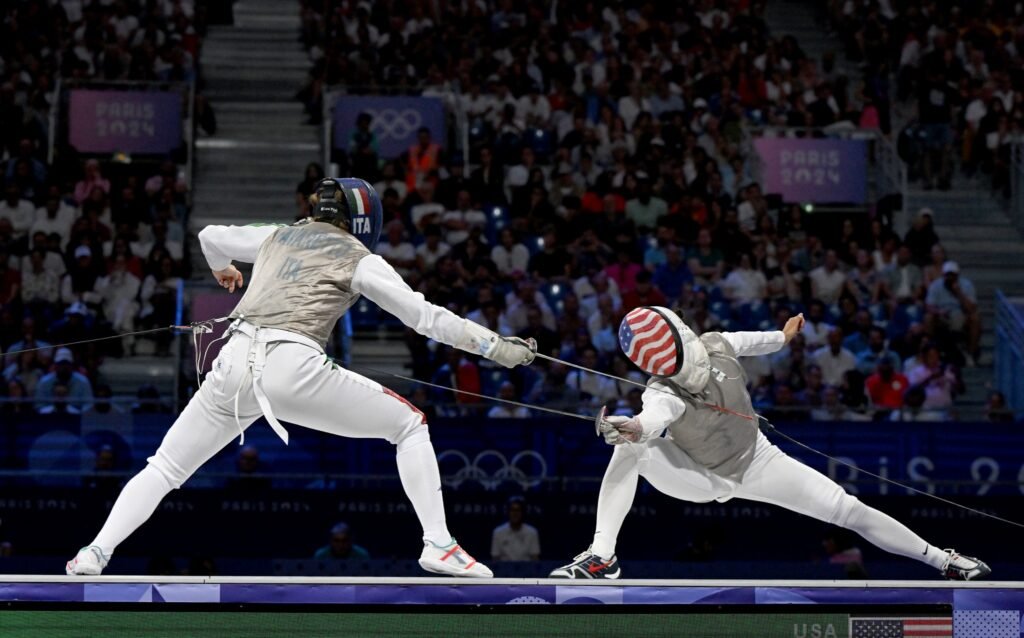
Strength training forms the foundation. Two to three sessions per week allow meaningful development without excessive fatigue. Free-weight lifts such as squats, deadlifts and presses build global force production and trunk stability. Unilateral exercises are particularly important in fencing, where the lead leg consistently absorbs more load. Addressing side-to-side imbalances improves efficiency and reduces injury risk. Upper-body strength should not be neglected. Shoulder stability, forearm capacity and grip strength directly influence blade control and help protect the elbow and wrist from repetitive stress. Strong calves and lower-leg musculature support propulsion and braking during fast footwork.
Plyometric training builds on this strength base. Early in the pre-season, extensive low-to-moderate intensity drills such as skipping, low hops and pogo jumps improve tendon capacity and elastic qualities. These adaptations enhance the ability to store and release energy efficiently during lunges and directional changes. As resilience increases, more intensive reactive exercises can be introduced to improve explosive power and reduce ground contact time. This progression supports both performance and tissue robustness.
Conditioning also plays a strategic role. Although fencing is intermittent, a well-developed aerobic base improves recovery between exchanges and across long competition days. Steady aerobic sessions enhance cardiovascular efficiency and peripheral adaptations that support oxygen delivery and utilisation. High-intensity intervals can then be layered on top to prepare the athlete for repeated high-intensity efforts typical of bouts. Together, these systems allow fencers to maintain technical precision under fatigue.
Core training links the upper and lower body. Efficient force transmission through the trunk supports stable lunges, controlled recoveries and accurate blade work. Integrating rotational and anti-rotational exercises enhances the coordination required for fencing’s asymmetrical demands.
As competitions approach, training shifts from accumulation to consolidation. Volume is reduced while maintaining exposure to strength, power and conditioning. This approach preserves physical qualities without creating unnecessary fatigue. The aim is to arrive at the first competition physically prepared, not physically exhausted.
Pre-season is not about doing more. It is about doing the right work at the right intensity to build capacity. When strength, elastic qualities and conditioning are developed systematically, technical and tactical training can be expressed at a higher level. Physical preparation serves fencing performance, and a well-structured pre-season ensures that performance can be sustained throughout the year.